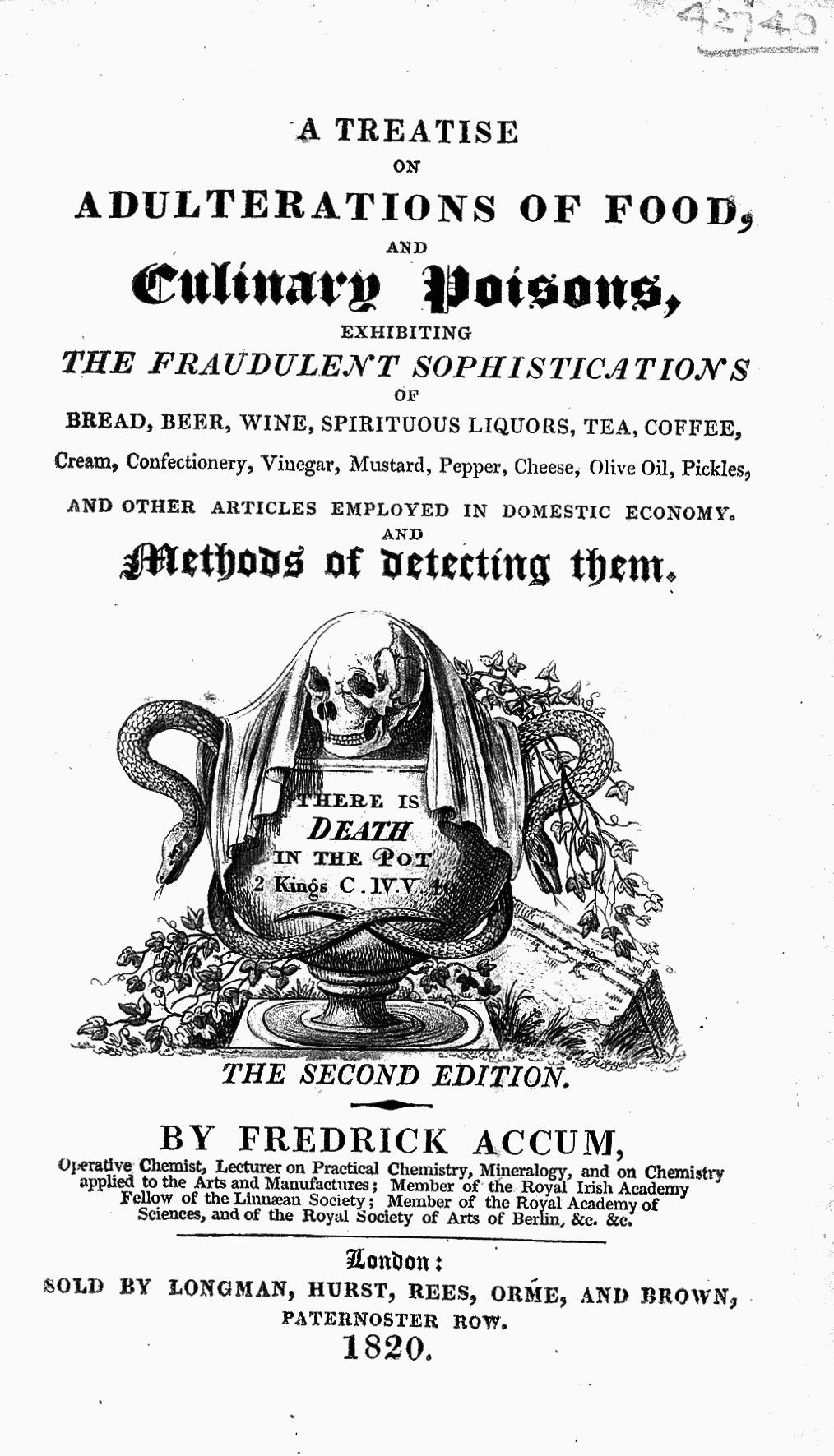
In 1820 a German chemist living in London, Frederick Accum, published a book with a skull on its title page and a line from the Book of Kings beneath it: “There is death in the pot.” The book named the tricks and, in places, the shops. Red lead in cayenne pepper. Copper salts to keep pickles green. A thousand copies sold within a month.
Accum’s readers were not careless. They lived in cities, a long way from the farms and mills that made their food, and they had no way to test what they bought. The market for food had grown past the point where a buyer could check it, and nobody else was checking it either. That gap lasted most of the century.
Figure 1
We went back through twelve markets that grew in the same way, from medieval long-distance trade to credit ratings, online marketplaces and crypto. We wanted to know what it cost when buyers could not check what they were sold, and what finally let them. We did this because the market for AI agents looks like the next one on the list.
Growth came first, every time
Each of these markets got big before anyone could check what it sold. Buyers went on brand names, word of mouth and whatever the small print said. The things that let buyers price quality came later: standard grades, inspection, liability, warranties that meant something, independent testing. Here is how much later.
| Market | Mass market by | The check that worked | Gap |
|---|---|---|---|
| British food | 1820s | Public analysts from 1872, food law 1875 to 1899 | 55 to 80 years |
| US patent medicine | 1850s | Proof of safety before sale, 1938 | About 80 years |
| US cars | 1920s | Henningsen ruling 1960, federal Safety Act 1966 | 30 to 45 years |
| Online marketplaces | Late 1990s | US product-safety and fake-review rules, 2024 | About 20 years |
| Software | 1980s | EU product liability for software, December 2026 | About 40 years |
Growth alone never moved things along. Each step came after a scandal: a run of deaths, a crash, or a court case that made the old arrangement impossible to defend.
The same five steps
British food set the pattern. First someone measured the problem privately. Accum did it in 1820. In the early 1850s the medical journal The Lancet paid a doctor, Arthur Hill Hassall, to buy about 2,500 samples from ordinary shops and test them. He found adulteration was “the rule rather than the exception”.
Then came disclosure. From 1853, coffee mixed with chicory had to say so on the label. Then a ban that nobody enforced: the Adulteration Act of 1860 had no inspectors and no real penalties, and little changed. Then someone was paid to test, with public analysts from 1872. A working framework followed in 1875 and was patched until 1899.
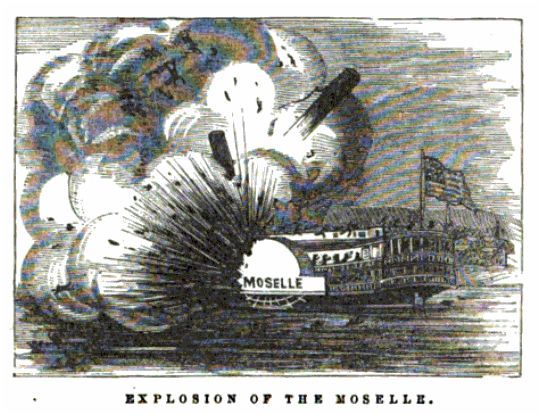
River steamboats ran the same course. Boilers exploded more than 230 times between 1816 and 1848. After more than 300 deaths in the spring of 1838, Congress passed a first safety law that bigger boilers soon outran. The law that worked, with pressure tests, licensed engineers and paid inspectors, came in 1852. Safety had been improving before then as owners learned. The law sped that up; it did not start it.
Figure 2
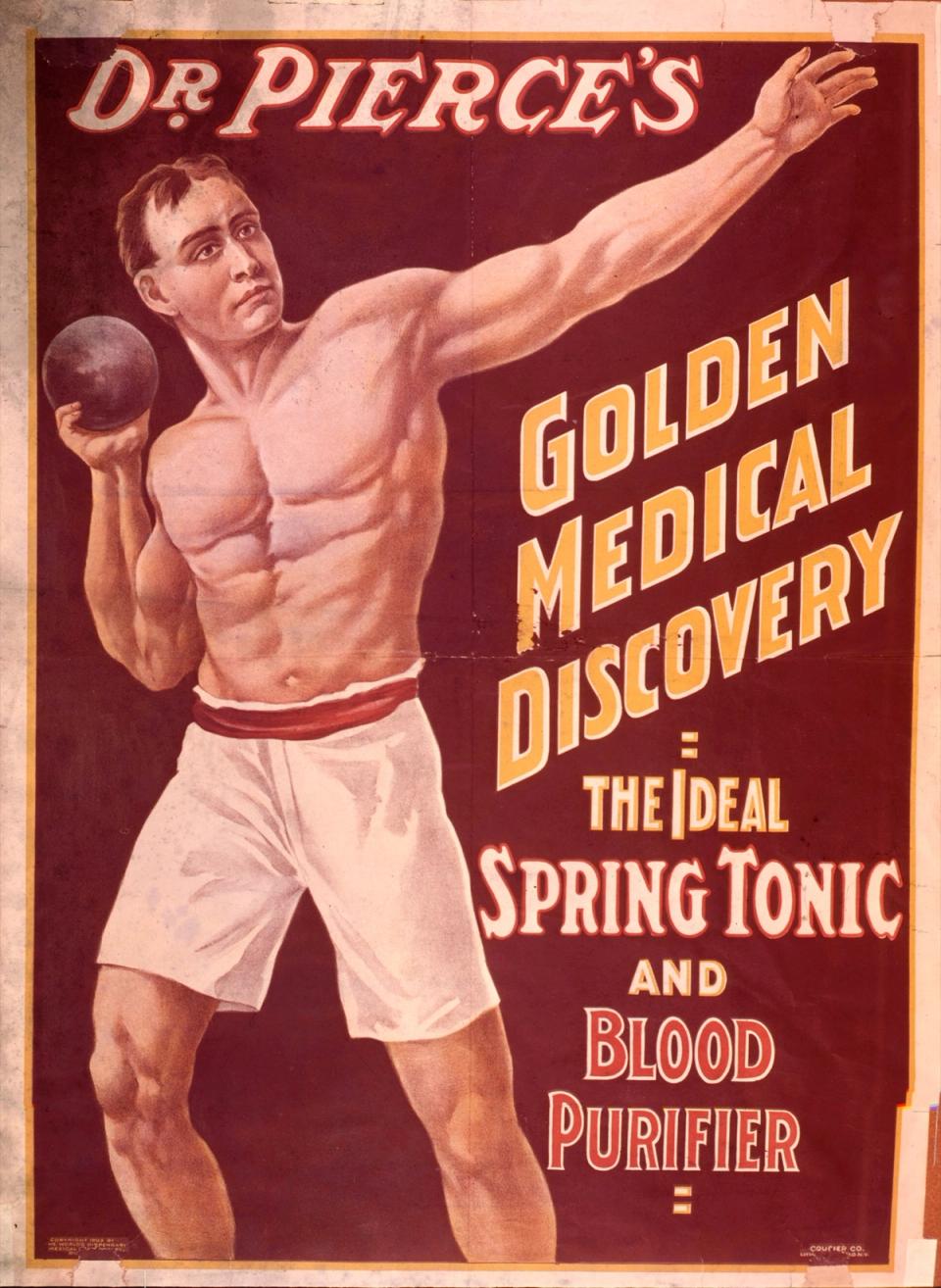
The United States went through the same steps with medicine. Patent medicine sales grew from $3.5 million in 1859 to about $74.5 million by 1904. Makers did not have to list ingredients, show that a product worked or show that it was safe. Journalists did the testing. The Pure Food and Drugs Act of 1906 banned adulterated and mislabelled products but checked nothing before sale.
In 1937 a company dissolved a new sulfa drug in diethylene glycol, a toxic solvent, and sold it as Elixir Sulfanilamide. More than 100 people in 15 states died. The government could seize the remaining bottles only because an “elixir” was supposed to contain alcohol and this one did not. The next year Congress required drug makers to prove safety before sale. That was the step that worked, and it came 32 years after the first law.
When liability worked
Liability is the obvious fix: make the seller pay when the product fails. The record shows it worked under narrower conditions than people tend to assume.
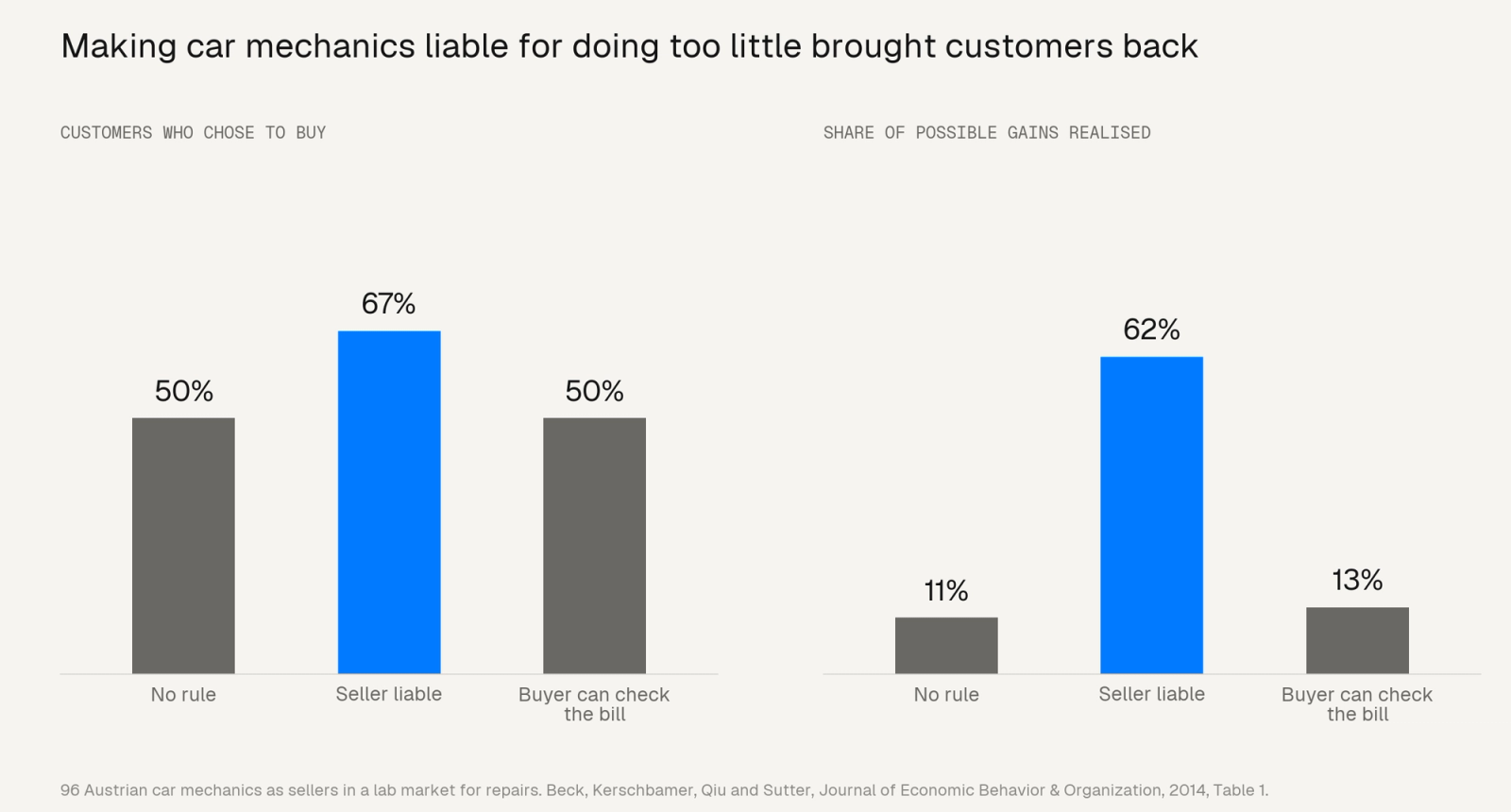
It worked in securities. The Securities Act of 1933 made companies liable for false statements when they sold shares. Afterwards, the mispricing of new issues fell most among small, little-known companies, the ones investors had known least about. It worked in the laboratory too. In experiments where sellers know more than buyers about what a job needs, making sellers liable for work that fell short improved the market sharply, while letting buyers see what they got barely helped. A study with car mechanics found the same: liability raised market efficiency from 0.11 to 0.62, and verifiability only to 0.13.
It failed when the harm showed up too late. Courts applied strict liability to asbestos in 1973, decades after the medical evidence was in. By 2004 more than 730,000 people had made claims, about $70 billion had been spent and more than 73 companies had gone bankrupt. Of each dollar spent, 42 cents reached the people who were harmed. The sellers that liability should have screened out were already gone.
It also failed when every seller used the same terms. Until 1960, American carmakers gave the same warranty, written by their trade association: 90 days or 4,000 miles, with every other duty disclaimed. A buyer could not shop for better terms, so the warranty said nothing about which car was better. That year a New Jersey court struck it down in Henningsen v. Bloomfield Motors.
Three years later Chrysler, trying to repair its name after years of poor quality, offered five years or 50,000 miles on the engine and transmission. A warranty that long is expensive for a maker of bad cars and cheap for a maker of good ones, which is why buyers could read something into it. GM and Ford matched it. When Chrysler’s quality slipped, it cut the warranty to one year for its 1969 models.
Taken together, liability sorted good sellers from bad only when four things held:
- worse sellers expected to pay more;
- failures showed up before the seller could leave;
- the seller could pay;
- no standard contract or flat-rate insurance made every seller look the same.
Why a lawsuit was rarely enough
Most of these markets already had courts and contract law. Buyers could, in principle, sue. They rarely got far, and the reasons repeat from case to case.
You could only sue the party you had a contract with. In 1842 an English court threw out a coachman’s claim against the firm that maintained the mail coach that collapsed under him, because his contract was with someone else. Once goods reached buyers through dealers, the maker was out of reach. American courts let car buyers past the dealer only in 1916, in MacPherson v. Buick.
Sellers wrote liability out of the contract. The carmakers’ shared warranty did exactly that, and buyers could not bargain over it.
Buyers could not prove what went wrong. A patient, an investor or a customer of a repair shop often cannot tell whether the work was bad, let alone show it in court. The EU’s new product liability rules admit as much: where technical complexity makes proof too hard, a court can now presume the product was defective.
The harm showed up too late, or the seller could not pay. By the time asbestos claims reached court, many of the firms that had made and sold it were bankrupt.
Suing cost more than it won. For widely sold products, Polinsky and Shavell estimate more than a dollar of legal cost for every dollar paid to victims. And most losses were too small to take to court at all. Lawyers call these negative-value claims, and the American class action exists largely to deal with them. Britain’s 1860 food law left it to someone to bring a case, and historians describe it as a dead letter.
Sometimes the law itself stood in the way. Since 1996, Section 230 has protected American online platforms from liability for what others list on them. Strict liability covered products, not services, and whether software counted as a product stayed unclear for decades. The EU settles that question from December 2026.
For a lawsuit to discipline sellers, a court has to be able to see the failure, reach the seller and collect. In most of the markets we looked at, at least one of those was missing. That is why the fixes that worked were usually something else: a paid tester, proof before sale, or a checker funded by whoever bore the loss.
Who pays the inspector
Every check has two sides: someone who relies on it, and someone who does it. Economists call them the principal and the agent, and the risk that the agent ends up working for someone else is the principal–agent problem. In the history of testing, one question decided whether the check held up: who pays the agent?
Fire insurers had a problem in the 1890s. Electric power was spreading fast, electrical fires were starting to worry them, and every fire was a claim they had to pay. In 1893 underwriters sent an engineer, William Henry Merrill, to check the wiring at the World’s Fair in Chicago. The next year, with money from Chicago insurers, he set up a laboratory to test electrical products before they were sold. It started with two staff and $350 of equipment, and became Underwriters Laboratories.
Here the principal and the payer were the same. If the lab approved a bad product and that product started a fire, the insurers who funded the lab paid for the fire. They had every reason to want the lab to be strict.
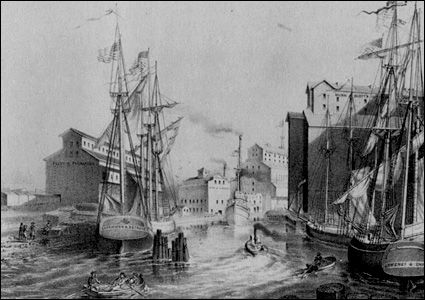
Chicago shows the opposite. From 1856 the Board of Trade graded grain, which let sacks of wheat become tradable receipts and, later, futures. The graders were supposed to serve everyone who bought a receipt. But the warehouses that stored and graded the grain belonged to men who sat on the Board and traded it, so the agents were working for themselves. Some mixed grades and issued receipts for grain that was not there.
Figure 3
A century and a half later the same problem returned at far larger scale. The principals of a credit rating are the investors who rely on it, but the agencies were paid by the banks whose bonds they rated. Before April 2007, 91.2% of the collateralised debt obligations rated AAA met only the agency’s own standard for AA. Arthur Andersen worked, on paper, for the shareholders of Enron and WorldCom. It was paid by the companies it audited, and sold them consulting on top.
| Check | Who relied on it | Who paid for it | Did it hold |
|---|---|---|---|
| Underwriters Laboratories, from 1894 | Insurers and their customers | Fire insurers | Yes |
| Chicago grain grades, from 1856 | Anyone holding a receipt | Warehouse owners who also traded | No |
| Credit ratings, 2000–2007 | Investors | The banks issuing the bonds | No |
| Enron and WorldCom audits | Shareholders | The companies being audited | No |
| Benchmarks for AI models, today | Companies buying AI | Mostly the companies being measured | Not yet known |
Can the rules be captured?
There is a serious argument against all of this. In 1971 the economist George Stigler argued that industries tend to get the regulation they want, and that rules usually end up protecting the firms they cover. History gives him plenty of support.
Figure 4
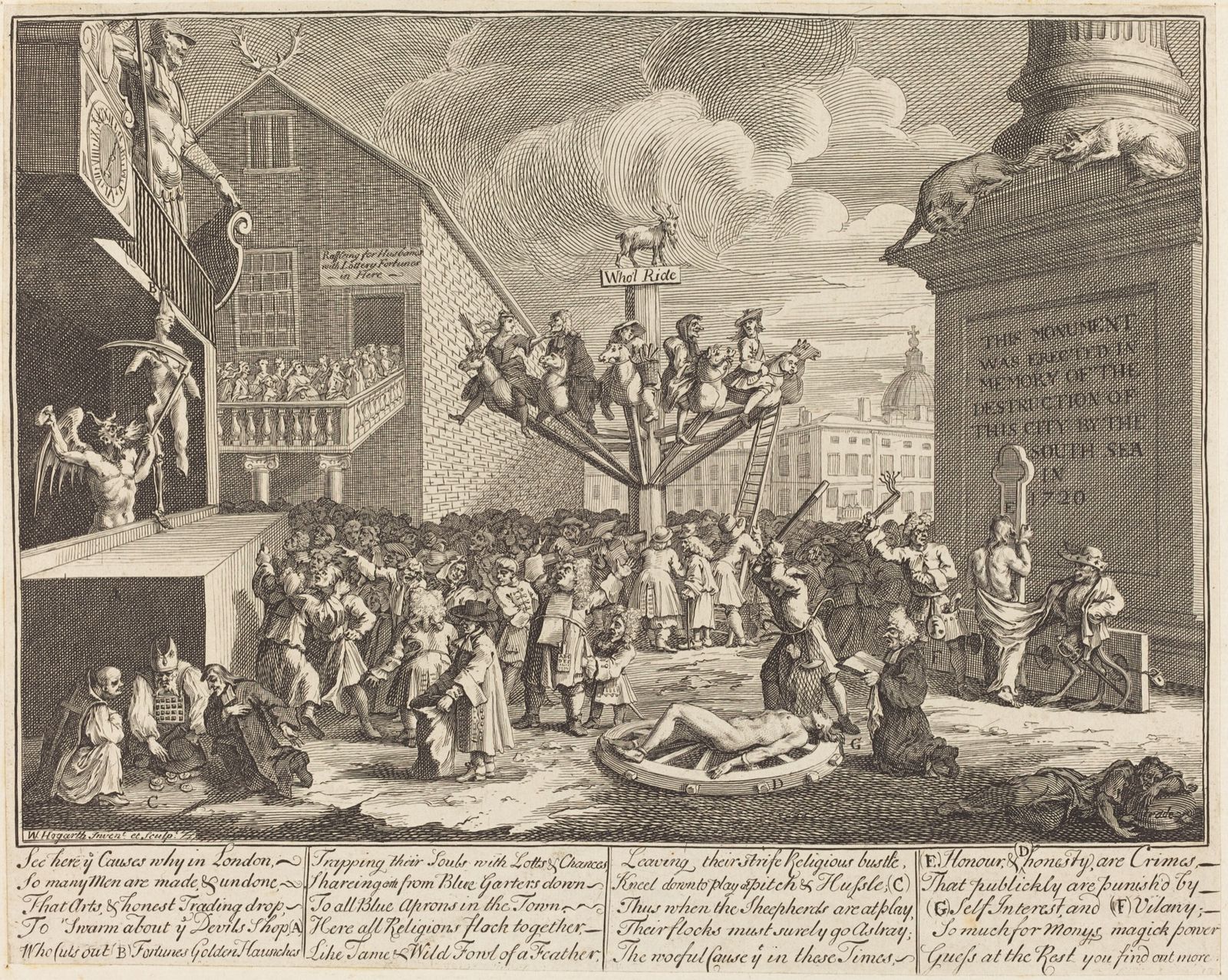
- The Bubble Act of 1720 banned joint-stock companies that lacked a royal charter. The historian Ron Harris found direct evidence that the South Sea Company, which had a charter, helped get it passed. It stayed in force for 105 years.
- Medicine. After the Flexner Report of 1910, the number of US medical schools fell from 155 to 66 by 1935. Many were bad, and closing them helped patients. But the economist Reuben Kessel argued in 1958 that the American Medical Association also won control over who could enter the profession, and used it.
- Meat. The historian Gabriel Kolko argued that the big Chicago packers wanted federal inspection in 1906, because it put the cost of inspection on the government. Gary Libecap found that the earlier inspection law of 1891 came partly from the need to reopen European markets that had banned American pork.
The evidence is more mixed than the theory, though. Patrick Newman’s recent work on the meat laws finds the packers were one interest group among several, mostly lobbying against rivals’ proposals, and that they did not get everything they wanted. Marc Law and Gary Libecap find that the food and drug law of 1906 passed with support from consumers, journalists and parts of industry, and that industry could not control how it was enforced afterwards. A 2013 collection edited by Daniel Carpenter and David Moss argues that capture is often claimed and rarely measured, and that it can be prevented.
Our reading is that capture is real, and that you can predict where it happens: where the firms being judged write the standard, where the checker also trades, or where only established firms can afford the cost of entry. It is much less likely where the one paying for the check loses money when the check is wrong. And the answer to capture was rarely to have no checks at all. The markets without them paid in poisoned food, dead patients and bankrupt defendants.
Did the checks make markets bigger
Every market on our list grew large before anyone could check it, so checks are clearly not needed for growth. The better question is what those markets looked like without them. The research points to one answer: smaller where buyers knew least.
When the United States extended its disclosure rules to large over-the-counter companies in 1964, the shares of the companies most affected beat comparable shares by 11.5 to 22.1% while the law went through. Across 49 countries, those with weaker protection for investors have smaller stock and bond markets. On eBay, guaranteeing buyers their money back pushed more poor sellers out and raised total welfare by about 2.9%. When Los Angeles made restaurants post their hygiene grades in 1998, hygiene improved, restaurants with an A took in more money, and hospital admissions for food poisoning fell.
The car-mechanics experiment shows the same thing in miniature: once sellers were liable for doing too little, the share of customers willing to buy at all rose from half to two-thirds.
Figure 5
Where studies split the gains by seller, they went to the sellers buyers knew least about. After 1933, mispricing fell most among small companies that had never issued shares before. On eBay, the Top Rated Seller badge was worth most to sellers with short track records, in crowded markets where few others had it.
Checks can also shrink a market. When the United States tightened drug approval in 1962, new drugs fell from about 43 a year to about 17. Sam Peltzman estimated the net effect as equal to a 5 to 10% tax on medicine, a figure that is still argued over. A check that makes quality visible tends to grow trade. One that mostly adds delay, or that incumbents write for themselves, tends to shrink it.
The same story, faster
AI agents are the newest market on the list, and the fastest-growing. Gartner expects worldwide spending on AI of about $2.67 trillion in 2026. It also estimates that, of the thousands of vendors selling “agentic” AI, about 130 offer real agentic capability, and it expects more than 40% of agentic AI projects to be cancelled by the end of 2027.
Most of the old gaps are back.
| Then | AI agents now | |
|---|---|---|
| Who can be sued | Only the dealer, until 1916 | The company that deploys the agent, not the model vendor |
| The fine print | One warranty for every carmaker, until 1960 | “As is”, with liability capped at the fees paid |
| Who counts the results | Grain graders who also traded | Vendors count their own “resolutions” |
| Who certifies | Rating agencies paid by the issuers | Benchmarks run or paid for by the model makers |
| Who carries the loss | Fire insurers, who built their own lab | Insurers, just starting to price AI errors |
| The law | Proof of safety came 32 years after the first drug law | EU product liability covers software from December 2026, but not pure financial loss |
The details are specific. When Air Canada argued that its chatbot was responsible for its own answers, a Canadian tribunal disagreed, and no court has yet held a model vendor liable for something its model made up. When a faulty CrowdStrike update crashed millions of Windows computers in July 2024, Fortune 500 companies lost an estimated $5.4 billion, and only 10 to 20% of that was insured. Before releasing Llama 4, Meta tested up to 27 private variants on a public leaderboard. And the EU withdrew its proposed AI Liability Directive in 2025, so for most agent mistakes there is still no EU-wide rule on who pays.
History suggests that liability alone will not sort agent vendors. Their failures show up within days, which helps. But many vendors are small and could not pay a large claim, and standard “as is” terms make them all look alike. What liability does is create a need for proof. The screening will then be done by whoever prices that liability, and insurers are the obvious candidates. Some already sell cover that pays out when a model performs worse than an agreed baseline. That is the Underwriters Laboratories route, and it works only if whoever pays for the check loses when the check is wrong.
The other lesson is about the checkers. Rating agencies paid by issuers inflated their grades during the boom, and evaluations paid for by AI vendors are likely to do the same. Standards written by the largest labs deserve the same scrutiny Kessel gave the AMA.
What we take from it
We build verification for agentic work, so we have an interest in this argument, and we should say so. What the history says to us is simple. A check is worth what the person paying for it loses when it is wrong. A verifier paid by the seller it judges is a rating agency. A verifier whose verdicts the seller cannot move, and whose mistakes someone pays for, is closer to the laboratory the fire insurers built in 1894.
Accum’s book did not fix London’s bread. That took another half-century and public analysts paid to test it. We would like the market for agent work to get there faster.
Sources
Grouped by section. Links point to the original paper where it is freely available, otherwise to a summary or catalogue record.
Opening
- Frederick Accum, A Treatise on Adulterations of Food, and Culinary Poisons (London, 1820): Science History Institute, digitised first edition; first-month sales: ChemistryViews; contents and Accum’s exile: Royal Society of Chemistry
Growth came first, every time
- British food laws: Royal Society of Chemistry
- Patent medicine and the 1938 Act: University of Toledo; FDA
- US road deaths from 1930: NHTSA series, via Wikipedia; Henningsen v. Bloomfield Motors (N.J. 1960): Casemine
- Online marketplaces: CPSC ruling that Amazon is a distributor, 2024: Arnold & Porter; FTC fake-review rule, 2024: FTC
- Software: EU Product Liability Directive 2024/2853: EUR-Lex
The same five steps
- Hassall, The Lancet and the food laws of 1853–1899: Royal Society of Chemistry; “Historical aspects of the pure food laws”, British Journal of Nutrition
- Steamboat explosions and the Acts of 1838 and 1852: Smithsonian; Encyclopedia.com; safety improving before the law: Denault, Langlois and Kimenyi, working paper
- Patent medicine sales, 1859–1904: University of Toledo; journalists’ exposés: Samuel Hopkins Adams, The Great American Fraud (1905–06), Project Gutenberg
- 1906 Act and Elixir Sulfanilamide: FDA history; FDA, the sulfanilamide disaster
When liability worked
- Carol J. Simon, “The Effect of the 1933 Securities Act on Investor Information and the Performance of New Issues”, American Economic Review 1989
- Dulleck, Kerschbamer and Sutter, “The Economics of Credence Goods”, American Economic Review 2011
- Beck, Kerschbamer, Qiu and Sutter, “Car Mechanics in the Lab”, Journal of Economic Behavior & Organization 2014; figures from Table 1 of the working paper
- Borel v. Fibreboard Paper Products (5th Cir. 1973): Justia; asbestos claims and costs to 2004: RAND Institute for Civil Justice (2005), via Claims Journal
- The trade-association warranty and Henningsen: Casemine; Wikipedia
- Chrysler’s five-year warranty: Indie Auto; Oregon newspaper, October 1962
Why a lawsuit was rarely enough
- Winterbottom v. Wright (1842): Wikipedia; University of Texas teaching text; MacPherson v. Buick (N.Y. 1916): Wikipedia
- Presumption of defect in the EU directive: International Bar Association
- A. Mitchell Polinsky and Steven Shavell, “The Uneasy Case for Product Liability”, Harvard Law Review 2010; reply by Goldberg and Zipursky: Harvard Law School
- Negative-value claims and class actions: Harvard Law School; University of Texas
- The 1860 food law as a “dead letter”: P. J. Atkins, “Sophistication Detected” (1991); Victorian Web
- Section 230, Telecommunications Act of 1996: Free Speech Center, Middle Tennessee State University
Who pays the inspector
- Underwriters Laboratories and Merrill: UL history; Wikipedia)
- Chicago grain grading and the warehouses: American Heritage; William Cronon, Nature’s Metropolis (1991), course notes
- John Griffin and Dragon Yongjun Tang, “Did Subjectivity Play a Role in CDO Credit Ratings?”, Journal of Finance 2012
- Arthur Andersen, Enron and WorldCom: Washington University Law Review
Can the rules be captured?
- George Stigler, “The Theory of Economic Regulation”, Bell Journal of Economics and Management Science 2 (1971)
- Ron Harris, “The Bubble Act: Its Passage and Its Effects on Business Organization”, Journal of Economic History 1994
- Reuben Kessel, “Price Discrimination in Medicine”, Journal of Law and Economics 1958; medical school numbers: Washington University Becker Library
- Gabriel Kolko, The Triumph of Conservatism (1963): summary
- Gary Libecap, “The Rise of the Chicago Packers and the Origins of Meat Inspection and Antitrust”, Economic Inquiry 1992
- Patrick Newman, “Playing the Defense: The Beef Trust, Cronyism, and the 1891 and 1906 Meat Inspection Acts”, The Independent Review 2024
- Marc Law and Gary Libecap, “Corruption and Reform? The Emergence of the 1906 Pure Food and Drug Act and the 1906 Meat Inspection Act”, working paper
- Daniel Carpenter and David Moss (eds.), Preventing Regulatory Capture (Cambridge University Press, 2013): introduction
Did the checks make markets bigger
- Michael Greenstone, Paul Oyer and Annette Vissing-Jorgensen, “Mandated Disclosure, Stock Returns, and the 1964 Securities Acts Amendments”, Quarterly Journal of Economics 2006
- Rafael La Porta, Florencio Lopez-de-Silanes, Andrei Shleifer and Robert Vishny, “Legal Determinants of External Finance”, Journal of Finance 1997
- Xiang Hui, Maryam Saeedi, Zeqian Shen and Neel Sundaresan, “Reputation and Regulations: Evidence from eBay”, Management Science 2016
- Ginger Zhe Jin and Phillip Leslie on Los Angeles hygiene grade cards: Stanford GSB; “Reputational Incentives for Restaurant Hygiene”, AEJ: Microeconomics 2009; hospital admissions: Simon et al. 2005
- Car-mechanics experiment: Beck et al. (2014), as above
- 1933 Act: Simon (1989), as above
- Daniel Elfenbein, Raymond Fisman and Brian McManus, “Market Structure, Reputation, and the Value of Quality Certification”, AEJ: Microeconomics 2015
- Sam Peltzman, “An Evaluation of Consumer Protection Legislation: The 1962 Drug Amendments”, Journal of Political Economy 1973
The same story, faster
- Gartner, AI spending forecast, September 2026; agentic AI prediction, June 2025
- Moffatt v. Air Canada, 2024 BCCRT 149; no ruling yet against a model vendor (Garcia v. Character Technologies settled): Winston & Strawn
- CrowdStrike outage losses: Axios; insured share: Reinsurance News on Parametrix
- Prices per resolution: Intercom, Sacra; Zendesk, CMSWire
- Private Llama 4 variants: “The Leaderboard Illusion”, arXiv 2504.20879
- EU Product Liability Directive: EUR-Lex; withdrawal of the AI Liability Directive: RPC
- Insurance for AI errors: Armilla; The Decoder
Images
- Lead: poster for Dr. Pierce’s Golden Medical Discovery, U.S. Food and Drug Administration, public domain, Wikimedia Commons_(6857491166).jpg)
- Accum title page: Wellcome Collection, CC BY 4.0, Wikimedia Commons
- Chicago grain elevators, 1866: public domain, Wikimedia Commons
- William Hogarth, The South Sea Scheme (1721): National Gallery of Art, Washington, CC0, Wikimedia Commons
- Chart: drawn by Verified from Beck et al. (2014), Table 1
- Explosion of the Moselle: Lloyd’s Steamboat Directory, public domain, Wikimedia Commons,_illus._-_ex,_Lloyd%27s_Steamboat_Directory.jpg)